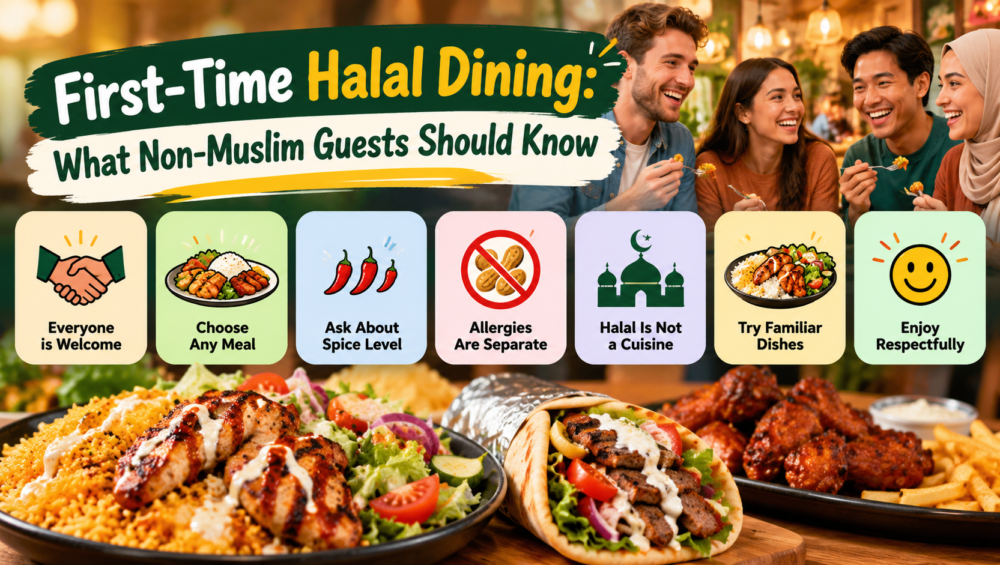
Can non Muslims eat halal food. The answer is Yes. Halal food is not restricted to Muslim diners. The term halal describes whether food is permissible under Islamic dietary rules. It does not mean that only Muslims are allowed to eat it. A non-Muslim customer can order halal chicken, lamb, rice, falafel, kebabs, burgers, gyros, or another halal meal in the same way they would order food from any restaurant. You do not need special permission, religious knowledge, or a particular reason for choosing halal food.
Many first-time diners are simply curious about the cuisine. Others visit a halal restaurant because they are eating with Muslim friends, coworkers, classmates, family members, or neighbors. Some choose the restaurant because they like the menu.
USDA guidance describes halal diets in terms of permitted and excluded ingredients, including restrictions involving pork, alcohol, and certain animal-derived products. It does not define halal food as something reserved for one group of customers.
At Zaki’s Halal Food in Queens, the menu includes familiar foods such as chicken over rice, lamb gyros, falafel, kebabs, burgers, and sandwiches.
Can Non Muslims Eat Halal Food and Why Does It Matter in Queens?
Can non Muslims eat halal food is especially relevant in Queens because people from many cultural and religious backgrounds share the same neighborhoods, workplaces, schools, and restaurants.
Food often becomes an easy way to experience another community without needing to adopt its religious beliefs.
The phrase halal food for non Muslims simply refers to halal meals being enjoyed by diners who do not personally follow Islamic dietary law.
There is no separate version of the meal.
A chicken over rice platter does not change depending on the religion of the customer. A restaurant prepares the halal food according to its standards, and customers choose whether they want to eat it.
Understanding this point can make group dining easier.
If one person in a group requires halal food, choosing a halal restaurant can give that diner suitable options while allowing everyone else to enjoy the same meal.
It is still important to distinguish halal from other dietary needs. Someone who is vegetarian, vegan, gluten-free, dairy-free, or managing a food allergy should ask their own questions.
Halal status does not automatically answer those concerns.
For a closer look at the restaurant and its local background, read About Zaki’s Halal Food. The business describes itself as a family-owned restaurant serving South Richmond Hill and the wider Queens community.
Can Non Muslims Eat Halal Food? Common Questions at a Glance
Can non Muslims eat halal food without changing how they normally dine? Yes.
The table below addresses common concerns from people who have never visited a halal restaurant.
| Question | Short Answer | What to Know |
| Can a non-Muslim order halal food? | Yes | Halal food can be eaten by anyone |
| Do I need to follow Islam? | No | Halal describes the food |
| Can I order a burger? | Yes | Many halal restaurants offer familiar dishes |
| Is every halal meal spicy? | No | Spice depends on the recipe |
| Is halal the same as vegetarian? | No | Halal meals can contain meat |
| Is halal automatically gluten-free? | No | Check ingredients separately |
| Do I need special etiquette? | Normal respectful dining is enough | Ask staff if unsure |
A common question about who can eat halal food comes from the mistaken idea that religiously compliant food must be consumed only by people of that religion.
Food standards do not work that way.
Kosher food, vegetarian food, vegan food, gluten-free food, and halal food may all be chosen by people who do not personally follow the belief or dietary system behind the label.
The practical question is simply whether the meal fits your own preferences and needs.
Tips for First-Time Diners Asking Can Non Muslims Eat Halal Food
Can non Muslims eat halal food comfortably at a halal restaurant? Absolutely. Treat the experience like any other restaurant visit.
You may want to ask about unfamiliar menu items, spice levels, sauces, or portion sizes, but you do not need to explain why you are there.
- Choose a dish based on flavors you normally enjoy.
- Ask staff to explain unfamiliar menu names.
- Mention food allergies separately.
- Ask about spice levels if you prefer mild food.
- Try a rice platter or gyro if you want a familiar starting point.
- Consider falafel if you want a meat-free option.
- Be respectful of the restaurant’s dietary practices.
Some people ask is halal food only for Muslims because they are worried that ordering it may be disrespectful. It is not disrespectful to purchase and enjoy halal food at a restaurant serving the public.
In fact, being interested in the food and asking respectful questions can make the experience more enjoyable.
You can review the Zaki’s halal menu before visiting. Current categories include rice platters, gyros, pita platters, kebabs, burgers, sides, biryani, and seafood.
Why Can Non Muslims Eat Halal Food Is Also a Group-Dining Question
For many people, can non Muslims eat halal food becomes important when planning a meal for a mixed group.
Imagine a workplace lunch with eight people. Two require halal meat, one is vegetarian, and the rest have no religious dietary restrictions.
A halal restaurant can potentially make the group decision easier because the customers who require halal meat have suitable meat choices while the other diners can order according to taste.
The vegetarian diner still needs an appropriate vegetarian dish, of course.
Zaki’s offers meat-based dishes as well as falafel items. Its current menu lists Falafel Over Rice, Falafel Gyro, and Falafel Pita Platter alongside chicken, lamb, beef, and seafood dishes.
That variety can be helpful for families, office groups, students, or friends who have different preferences.
Halal dining can also introduce people to dishes they may not normally order.
Someone accustomed to burgers might try a gyro. Someone who likes grilled food could choose a kebab. A diner who prefers rice bowls can start with chicken or lamb over rice.
You can browse Zaki’s food for online ordering to see different meal types before making a group order.
Can Non Muslims Eat Halal Food? Menu Options for First Visits
Can non Muslims eat halal food if they are unfamiliar with Middle Eastern flavors? Yes, and you can start with food that already feels familiar.
| If You Usually Like | Try | Why It May Feel Familiar |
| Rice bowls | Chicken Over Rice | Protein, rice, salad, sauce |
| Wraps | Chicken Gyro | Meat and toppings in pita |
| Burgers | Halal Cheese Burger | Familiar burger format |
| Grilled chicken | Chicken Kabab | Grilled seasoned protein |
| Vegetarian meals | Falafel Over Rice | Plant-based main option |
| Mixed platters | Mixed Over Rice | Chicken and lamb together |
| Fish and rice | Tilapia Fish with Rice | Familiar seafood combination |
Zaki’s current menu lists these and related items with prices, though availability and pricing can change.
For people trying halal food for the first time, Chicken Over Rice can be a simple entry point because it uses recognizable ingredients and allows diners to experience the restaurant’s seasoning and sauces.
There is no requirement to start with the most traditional-looking dish.
Choose what you genuinely want to eat.
That is one reason halal restaurants can appeal to a broad customer base. Religious compliance and mainstream dining formats can exist in the same meal.
Why Choose Zaki’s When Asking Can Non Muslims Eat Halal Food in Queens?
Zaki’s positions itself as a welcoming neighborhood restaurant serving South Richmond Hill and Queens. Its stated goal is to provide halal food with friendly service in a clean and welcoming environment.
For non-Muslim first-time diners, the menu has the advantage of familiarity.
You can choose burgers and chicken sandwiches or move toward gyros, rice platters, falafel, biryani, and kebabs.
This allows diners to explore at their own pace.
There is also no need to understand every Islamic dietary rule before ordering. The restaurant is responsible for explaining how it represents its food, while the customer can focus on taste, allergies, preferences, and any questions that matter personally.
For more guides about halal dishes and local dining, visit the Zaki’s Halal Food blog.
Can Non Muslims Eat Halal Food and Enjoy the Same Meal as Muslim Friends?
Image Recommendation: A diverse group of adult friends sharing rice platters, gyros, falafel, and grilled dishes around one restaurant table.
Alt text: “Muslim and non-Muslim friends sharing halal food together in Queens NY”
Can non Muslims eat halal food at the same table as Muslims? Yes. Shared meals are one of the most straightforward situations where halal restaurants can be convenient.
If Muslim diners require halal food, selecting a restaurant that serves halal meals can remove one major concern.
The non-Muslim members of the group can still choose dishes based on flavor.
They do not need to order differently because of their religion.
The main practical issue is individual dietary needs. One person may avoid dairy. Another may be allergic to sesame. Someone may want a vegetarian meal.
Those needs should still be communicated separately.
Halal answers one category of dietary requirement. It does not replace every other food label.
For an authoritative overview of what halal diets generally exclude, see the USDA halal foods guidance.
Frequently Asked Questions: Can Non Muslims Eat Halal Food
Can non Muslims eat halal food is usually followed by questions about religion, taste, price, restaurant etiquette, and what to order first. Here are clear answers for first-time diners.
1. Can non Muslims eat halal food?
Yes. Anyone can eat halal food. The term describes food that complies with Islamic dietary requirements rather than restricting which customers may consume it.
2. Do non-Muslims need to follow any religious ritual before eating halal food?
No. A customer does not need to perform a religious ritual before ordering or eating a halal restaurant meal.
Normal respectful dining behavior is enough.
3. Is halal food more expensive for non-Muslims?
No restaurant should charge a different price because of a customer’s religion.
Menu prices apply to the dish. Zaki’s lists current prices publicly on its menu, and customers should check those prices before ordering because they can change.
4. Does halal food take longer to prepare?
Not because it is halal. Restaurant preparation time depends on the dish, kitchen workload, order size, and cooking method.
5. Can non-Muslims order halal meat?
Yes. Halal chicken, beef, and lamb can be purchased and eaten by non-Muslim customers.
6. Is it disrespectful for a non-Muslim to eat halal food?
No. Ordering food offered to the public by a halal restaurant is not inherently disrespectful.
Being polite to staff and other diners is the same basic expectation you would have in any restaurant.
7. Where can non-Muslims try halal food in Queens?
Zaki’s Halal Food is at 108-15 101st Ave, South Richmond Hill, NY 11419. It offers rice platters, gyros, kebabs, falafel, burgers, and additional items.
For questions before visiting, contact Zaki’s Halal Food.
Looking to try halal food in Queens?
Zaki’s Halal Food is located at 108-15 101st Ave in South Richmond Hill, Queens, NY 11419, near the intersection of 101st Avenue and 108th Street. The Q8 bus stops along 101st Avenue near 108th Street, making the restaurant easy to reach by public transportation. Nearby A train stations provide additional subway connections, while Liberty Avenue and the Little Guyana area are also close to this diverse Queens neighborhood. Whether you are Muslim or trying halal food for the first time, Zaki’s Halal Food welcomes everyone to enjoy fresh halal meals in South Richmond Hill.
Contact Information
Phone: +1 718-285-5191
Email:
info@zakishalalfoodusa.com
- Nearest bus: 101 Av /108 St — the Q8 bus runs along 101st Avenue and stops at 108th Street, essentially at the restaurant’s intersection. MTA confirms the Q8 operates between Jamaica and Gateway Center via 101st Avenue. MTA
- Nearby subway: 111 St and Ozone Park–Lefferts Blvd are nearby A train stations. For customer directions, I would mention 111 St (A train) first as a useful nearby subway connection.
- Another transportation reference: The Q8 continues east toward Jamaica, including Sutphin Blvd/Archer Ave and Jamaica Bus Terminal, giving customers connections to additional subway, bus, LIRR, and AirTrain services. MTA
- Local landmark/entity: Little Guyana Avenue on Liberty Avenue is a particularly useful cultural/geographic entity for South Richmond Hill. It is more locally relevant to your restaurant than using famous Manhattan attractions.
- You can also naturally reference Liberty Avenue, Richmond Hill, South Richmond Hill, Ozone Park, 101st Avenue, 108th Street, and Queens where relevant.